When most people think about fitness goals, they often focus on visible muscles—sculpted arms, defined legs, or six-pack abs. However, beneath these aesthetic aspirations lies something far more fundamental to overall health and athletic performance: core strength. Your core is the powerhouse of your body, the central link that connects your upper and lower body, and the foundation upon which nearly every movement you make is built.
Understanding the importance of core strength and knowing how to develop it effectively can transform not only your fitness journey but also your daily life. From preventing injuries to improving posture, enhancing athletic performance to reducing back pain, a strong core is essential for everyone—from elite athletes to office workers, from young adults to seniors.
What Is Your Core?
Before diving into why core strength matters and how to build it, it's crucial to understand what the core actually encompasses. Many people mistakenly believe the core is simply the abdominal muscles or the "six-pack" muscles visible on the front of the torso. In reality, the core is a complex network of muscles that extends far beyond the abs.
Your core includes the rectus abdominis (the six-pack muscles), the internal and external obliques (side muscles), the transverse abdominis (deep abdominal muscles that act like a natural weight belt), the erector spinae (lower back muscles), the multifidus (small muscles along the spine), the pelvic floor muscles, the diaphragm, and even the hip flexors and glutes. This intricate system of muscles works together to stabilize your spine, pelvis, and shoulder girdle, creating a solid foundation for movement.
Why Core Strength Is Essential
1. Injury Prevention
One of the most compelling reasons to develop core strength is injury prevention. A weak core forces other muscles to compensate, leading to imbalances and strain. This is particularly evident in lower back pain, one of the most common complaints in modern society. Studies have consistently shown that individuals with weak core muscles are significantly more prone to lower back injuries and chronic pain.
When your core is strong, it acts as a natural brace for your spine, distributing forces evenly throughout your body during movement. This protection extends beyond the back to include reduced risk of shoulder injuries, hip problems, and even knee issues, as proper core engagement promotes better movement mechanics throughout the entire kinetic chain.
2. Improved Posture
In our increasingly sedentary world, poor posture has become epidemic. Hours spent hunched over computers, looking down at phones, and sitting in cars have created a generation of people with rounded shoulders, forward head posture, and weakened core muscles. A strong core helps maintain proper spinal alignment, counteracting these negative postural patterns.
Good posture isn't just about appearance—it affects breathing, digestion, circulation, and even confidence. When your core muscles are strong enough to hold your body in proper alignment without excessive effort, you'll find that you naturally stand taller, breathe more deeply, and move more efficiently.
3. Enhanced Athletic Performance
Regardless of your sport or physical activity of choice, core strength is fundamental to performance. Whether you're swinging a golf club, throwing a baseball, running a marathon, or lifting weights, power originates from your core and transfers through your limbs.
Consider a tennis serve: the power doesn't come primarily from the arm but from the rotation and stability of the core. A boxer's punch, a swimmer's stroke, a runner's stride—all of these movements rely heavily on core strength and stability. Athletes who prioritize core training consistently demonstrate improved power output, better balance, increased endurance, and superior movement efficiency.
4. Better Balance and Stability
Balance isn't just important for gymnasts and tightrope walkers—it's essential for everyday activities. Walking on uneven surfaces, carrying groceries, reaching for objects on high shelves, and even standing on one foot to put on shoes all require core stability.
As we age, balance becomes increasingly important for preventing falls, which are a leading cause of injury among older adults. A strong core provides the stability necessary to react quickly to unexpected changes in terrain or position, helping maintain equilibrium in challenging situations.
5. Functional Strength for Daily Life
Core strength isn't just about gym performance—it's about making everyday activities easier and safer. Picking up a child, carrying luggage, gardening, housework, and even sitting at a desk for extended periods all require core engagement.
When your core is strong, these activities become less taxing, and you're less likely to injure yourself during routine tasks. This functional strength translates to a higher quality of life and greater independence, particularly as you age.
6. Reduced Back Pain
Lower back pain affects millions of people worldwide and is one of the leading causes of disability. While back pain can have many causes, weak core muscles are frequently a contributing factor. The core muscles support the spine and help maintain its natural curves. When these muscles are weak, the spine lacks adequate support, leading to strain and discomfort.
Numerous studies have demonstrated that core strengthening exercises can significantly reduce chronic lower back pain and prevent its recurrence. By building a strong muscular foundation around the spine, you create a natural support system that reduces stress on vertebrae, discs, and ligaments.
The Best Exercises for Building Core Strength
Now that we understand why core strength is so important, let's explore the most effective exercises for developing it. The best core training programs incorporate exercises that challenge the core from multiple angles, including anti-extension, anti-rotation, and anti-lateral flexion movements, as well as exercises that promote dynamic stability.
1. Planks
The plank is often considered the gold standard of core exercises, and for good reason. This isometric exercise engages virtually every muscle in your core simultaneously while also working your shoulders, arms, and legs.
How to perform: Start in a push-up position but rest on your forearms instead of your hands. Your elbows should be directly beneath your shoulders, and your body should form a straight line from head to heels. Engage your core by pulling your belly button toward your spine, squeeze your glutes, and hold this position. Begin with 20-30 seconds and gradually increase duration as you get stronger.
Variations: Side planks target the obliques, while plank variations like shoulder taps, plank jacks, and walking planks add dynamic challenges that further enhance core strength.
2. Dead Bug
The dead bug exercise teaches core stability while coordinating opposite limb movements, making it excellent for developing functional core strength and preventing compensatory movement patterns.
How to perform: Lie on your back with arms extended toward the ceiling and knees bent at 90 degrees, shins parallel to the floor. Press your lower back into the ground by engaging your core. Slowly lower your right arm overhead while simultaneously straightening your left leg, hovering it just above the floor. Return to starting position and repeat on the opposite side. Perform 10-15 repetitions per side.
3. Bird Dog
The bird dog exercise challenges core stability while promoting coordination and balance. It's particularly effective for strengthening the lower back muscles and teaching proper spinal alignment.
How to perform: Start on your hands and knees with hands directly under shoulders and knees under hips. Engage your core and simultaneously extend your right arm forward and left leg backward until both are parallel to the floor. Keep your hips level and avoid rotating your torso. Hold for 2-3 seconds, return to start, and repeat on the opposite side. Perform 10-12 repetitions per side.
4. Pallof Press
The Pallof press is an anti-rotation exercise that builds tremendous core strength and stability. It teaches your core to resist rotational forces, which is essential for injury prevention and athletic performance.
How to perform: Attach a resistance band to a stable object at chest height. Stand perpendicular to the anchor point and hold the band with both hands at your chest. Step away from the anchor to create tension. Press the band straight out from your chest, resisting the rotational pull. Hold for 2-3 seconds, then return to your chest. Perform 10-15 repetitions, then switch sides.
5. Mountain Climbers
Mountain climbers combine core strengthening with cardiovascular conditioning, making them an efficient exercise for overall fitness.
How to perform: Start in a high plank position with hands directly under shoulders. Keeping your core tight and hips level, drive one knee toward your chest, then quickly switch legs in a running motion. Maintain a strong plank position throughout the movement, avoiding excessive hip rotation or elevation. Perform for 30-60 seconds.
6. Russian Twists
Russian twists target the obliques and rotational core strength, important for athletic movements and functional fitness.
How to perform: Sit on the floor with knees bent and feet flat. Lean back slightly while maintaining a straight spine. Lift your feet off the ground if possible. Hold your hands together in front of your chest and rotate your torso to the right, bringing your hands toward the floor beside your hip. Rotate to the left side. Continue alternating for 20-30 repetitions. Add weight for increased difficulty.
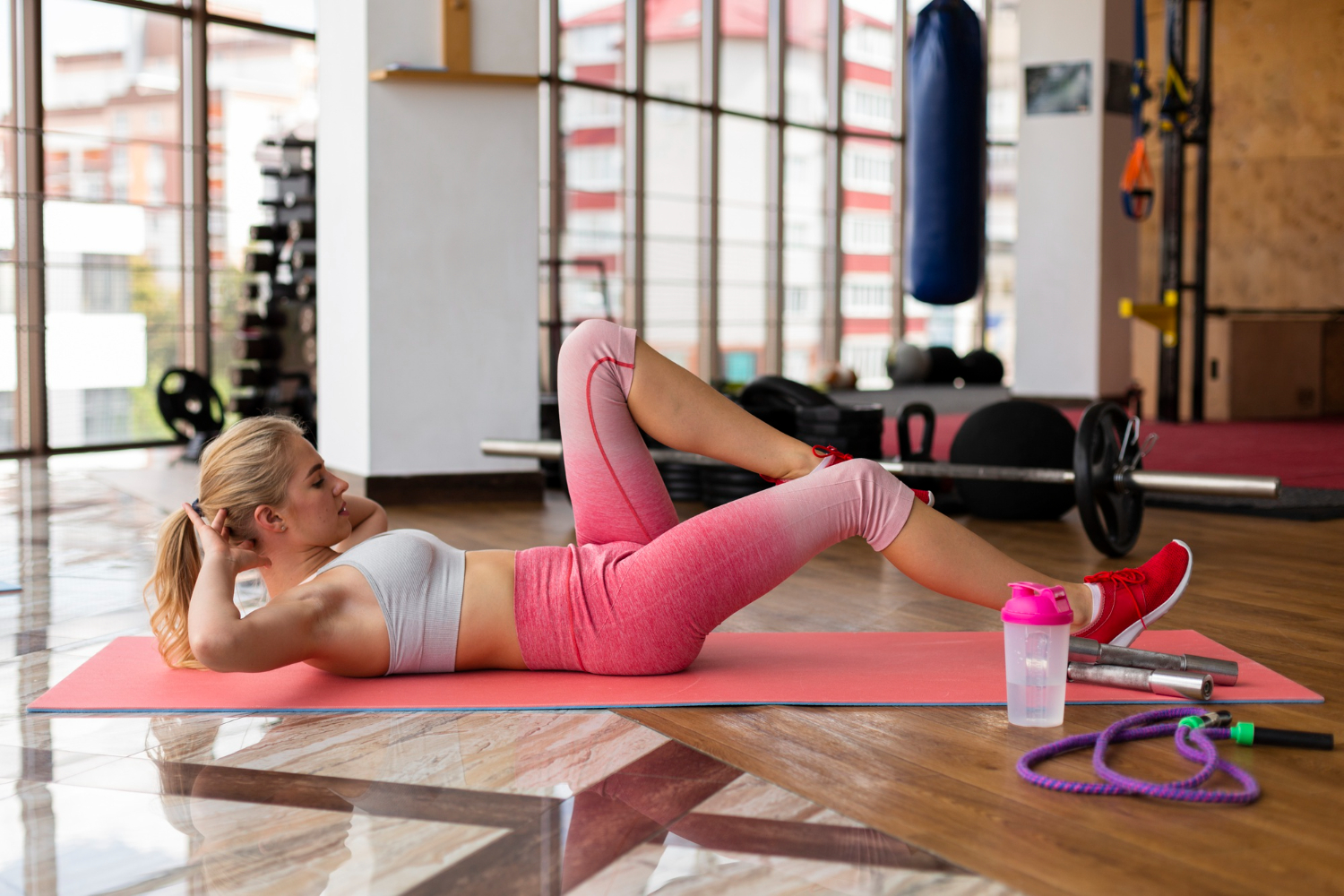
7. Bicycle Crunches
Bicycle crunches effectively engage both the rectus abdominis and obliques while promoting coordination.
How to perform: Lie on your back with hands behind your head and legs lifted with knees bent at 90 degrees. Bring your right elbow toward your left knee while straightening your right leg. Switch sides in a pedaling motion. Focus on rotating from your core rather than pulling on your neck. Perform 15-20 repetitions per side.
8. Hollow Body Hold
The hollow body hold is a gymnastics-inspired exercise that builds tremendous core strength and body awareness.
How to perform: Lie on your back with arms extended overhead. Press your lower back into the floor by engaging your core. Lift your shoulders, arms, and legs off the ground, creating a "hollow" position with your body. Hold this position for 20-45 seconds, maintaining constant core engagement.
9. Turkish Get-Up
The Turkish get-up is a complex, full-body movement that develops core strength, stability, and coordination. While challenging, it's one of the most functional core exercises available.
How to perform: This multi-step exercise begins lying on your back holding a weight (kettlebell or dumbbell) in one hand with that arm extended toward the ceiling. Through a series of movements involving rolling to your side, propping yourself up, sweeping your leg through, and standing up, you move from lying to standing while keeping the weight overhead. Reverse the movement to return to the starting position. Start with light weight and focus on proper form.
10. L-Sit
The L-sit is an advanced isometric exercise that builds exceptional core strength, particularly in the hip flexors and lower abdominals.
How to perform: Sit on the floor with legs extended. Place your hands on the floor beside your hips. Press down through your hands and engage your core to lift your entire body off the ground, keeping legs straight and parallel to the floor. Hold for as long as possible, starting with just a few seconds and building up over time.
Creating an Effective Core Training Program
To maximize the benefits of core training, incorporate these exercises into a well-rounded program. Aim to train your core 3-4 times per week, allowing adequate recovery between sessions. A balanced core workout should include:
- Isometric holds (planks, hollow body holds) for static stability
- Anti-rotation exercises (Pallof press) for rotational stability
- Dynamic movements (mountain climbers, bicycle crunches) for functional strength
- Compound exercises (Turkish get-ups, bird dogs) for integrated core development
Begin each core session with 5-10 minutes of general warm-up and mobility work. Start with 2-3 sets of each exercise, focusing on quality over quantity. As you progress, increase difficulty by adding resistance, duration, or complexity rather than simply doing more repetitions.
Conclusion
Core strength is far more than an aesthetic pursuit—it's a fundamental component of health, fitness, and quality of life. A strong core protects against injury, improves posture, enhances athletic performance, and makes daily activities easier and safer. By incorporating the exercises outlined in this article into your regular fitness routine, you'll build a solid foundation that supports everything you do, both in and out of the gym.
Remember that developing core strength is a journey, not a destination. Start with exercises appropriate for your current fitness level, focus on proper form, and progressively challenge yourself as you get stronger. With consistency and dedication, you'll develop the strong, stable core that serves as the foundation for a healthy, active life. Whether your goal is to eliminate back pain, improve your athletic performance, or simply move through life with greater ease and confidence, investing in core strength is one of the best decisions you can make for your long-term health and fitness.